Getting the photos in
Cameras that can send over FTPS or FTP upload on their own, over a mobile signal or Starlink. Cameras without a network connection work too. You copy the SD card from your laptop and the photos end up in the same place.
See what your cameras caught, and keep the data yourself.
A camera trap can come back with 40,000 photos, most of them grass moving in the wind. Untamed Data is the operational layer that sorts them: AI names the species, and a person checks what it isn't sure about. It runs in Europe, works with the cameras you already own, and your data stays yours.
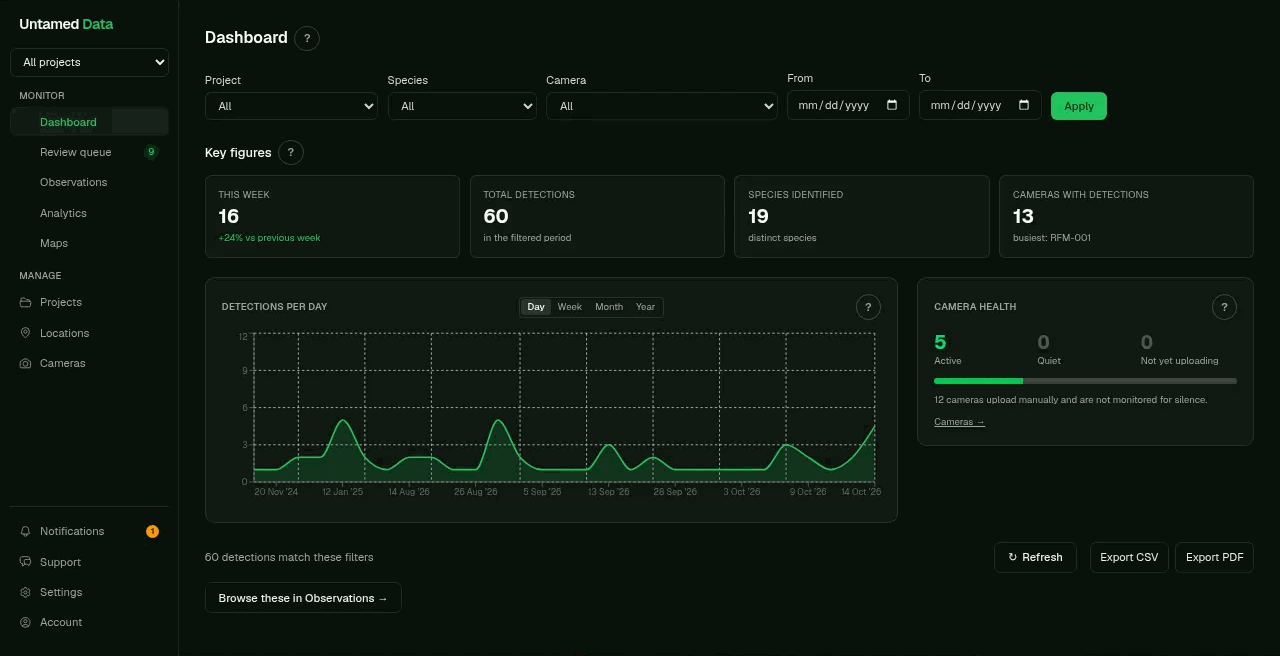
Demo dashboard with sample data
A demo with sample data. The platform gets regular updates, so your screens may look slightly different.
Supported by


How it works
Hanging the cameras is the easy part. The trouble starts later. Cards pile up in a drawer because nobody has time to go through them. The student who knew which folder was which finishes her thesis and leaves. The brand app only exports in its own format. Untamed Data is the operational layer between the camera and the result. In plain terms, it does the everyday work of getting the photos in and keeping them in order, for one camera or a grid of fifty, and the data stays in your account.
Cameras that can send over FTPS or FTP upload on their own, over a mobile signal or Starlink. Cameras without a network connection work too. You copy the SD card from your laptop and the photos end up in the same place.
Our species recognition runs on servers in Europe. It names the animal and moves the empty triggers out of the way, so you're not clicking through a night of swaying branches.
When the model isn't sure, the photo waits for a person to confirm or correct it. Everything else goes straight through.
Photos are filed by site and date under your account. You can see which cameras are sending and which have gone quiet, and whoever takes over next season finds everything where you left it.
Overview
Every detection on a chart and a map, on a laptop in the office or a phone in the field. Filter by species, camera and date, and the fox on the north grid or the first lynx in years is one search away. The analytics turn a season of photos into relative abundance (RAI) and daily activity patterns. Survey completeness shows how many camera days actually ran, which is what most monitoring programmes need to report.

Demo screenshots with sample data. The interface changes as we keep building.
Why this approach
You can keep using the cameras you already own, whatever the brand. The photos and detections belong to you, and storage and AI run on European servers. Reserves and research groups rarely find that together with a company that picks up the phone when something breaks.
The photos and detections are yours. Download a full copy whenever you like and keep it on your own drives, so your records never depend on us.
Storage and species recognition run on European servers, built with GDPR in mind from the start. Each detection notes which AI model and version made it, so years later you can still show how a number came about. Where each record comes from →
Export to Camtrap DP, the open format most camera-trap researchers use, or to CSV and PDF. A colleague at a university or another reserve can open it without our software. Standards & interoperability →
Connectivity
Cameras upload over whatever internet the site has. In a valley with no 4G, that might be a Starlink dish on the ranger post, and that works fine. You arrange the connection on site. Once the photos arrive, we take care of the rest. Starlink and remote sites →
Coming later: live cameras for sites where minutes matter, such as poaching hotspots or busy wildlife crossings, with detections and alerts as they happen. This will be a paid add-on.
Where it is used
A farmer wants to know which night the boar came through the maize. A fish farm wants to know what is taking its trout. A reserve wants to know if the lynx is really back, and a research group wants a grid of fifty cameras sorted before the next field season. They all use the same software.
Wild boar and deer in crops and vines. See which animals come and at what time, so you can act before the damage spreads. The dated photos help with a damage claim or a permit application.
Read more → Livestock, land & waterFox and wolf near grazing animals, or an otter at the fish ponds. Find out what is really coming and at what time of night before you decide what to do about it.
Read more → ConservationFollow which species come back to a forest or a wetland over the years, and export clear summaries for funders and partners.
Read more → ResearchRun each study as its own project, with a review queue for uncertain IDs and clean exports for analysis and publication. When a student finishes, the data stays with the project.
Read more →Who we are
Untamed Data B.V. is a Dutch company building the operational layer behind wildlife monitoring. Martijn, our founder, builds the software himself, and as a fly-fisher he spends a good part of his free time on riverbanks. We work with reserves, researchers and land managers, and with technical partners who install and connect the cameras. More about us →
How we work and the company details. Independent monitoring software from the Netherlands.
Advice on which cameras to buy and where to hang them, or hands-on help setting up in the field.
Research institutes and conservation groups, plus the integrators and technology companies we build with.
Next step
Upload a batch from an old SD card or a folder on your laptop and see what the platform makes of it. There's nothing to install.
